
Strange Strings
Review of "Spectral Sounds: Unquiet Tales of Acoustic Weird" (2022)

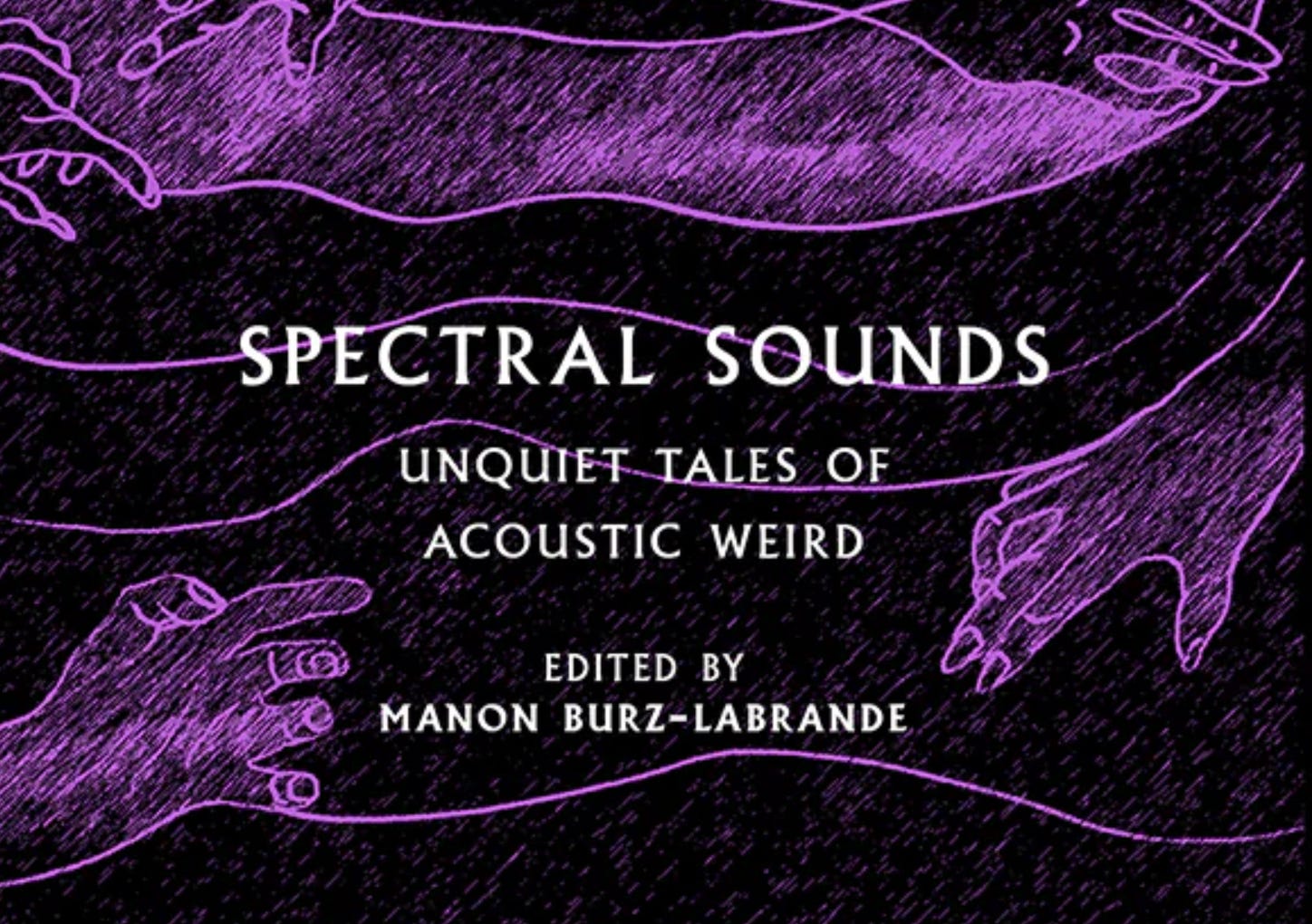
Manon Burz-Labrande (ed.) Spectral Sounds: Unquiet Tales of Acoustic Weird. British Library, 2022. 320pp.
The use of sound in Hitchcock’s Rear Window is one of the film’s most striking aspects (see my previous post, Her Entry, Jan 9, 2026). Beyond the brief, jaunty theme tune written by Franz Waxman for the opening credits sequence — and the ongoing composition of Lisa’s song as part of the film’s actual plot (the character of the Composer putting together the musical elements in a way that mirrors the blossoming of Jeff and Lisa’s relationship and their deduction of the crime) — there are no other examples of conventional scoring in the film. No musical accompaniment to heighten suspense, induce tension, or amplify the mise-en-scène. Instead, Hitchcock uses the quotidian sounds of the city (sirens, traffic, helicopters overhead), overheard conversations, distorted radio transmitters, heavy footsteps on the stairs, to assemble a musique concrète that foregrounds the everyday rattle and hum of the metropolis.
Not to mention the intimate and uneasy sounds that are our companions when we sit alone in the dark.
Spectral Sounds: Unquiet Tales of Acoustic Weird (2022) is an anthology volume in the British Library extensive series of themed collections highlighting various aspects of the weird and uncanny. The series uses out-of-copyright fantastic fictions (generally written 1850-1920), with an editor’s introduction and brief biographical note to each story. And, of course, the standard disclaimer apologising for “uses of language, instances of stereotyping and some attitudes expressed by narrators or characters which may not be endorsed by the publishing standards of today.”
It seems there’s nothing more transgressive than the past.